
Coaching: Generative & effective ?!?
In Business, coaching shall be tailored, focused and in short term effective. At the same time coaching is also a tool to unfold potentials. Different aims and hence different processes. While I use the GROW model from John Withmore often with managers for work performance issues, I refer to other processes such as the generative or co-active coaching, when it comes to unleash the dreams and the ‘not-yet-known’.
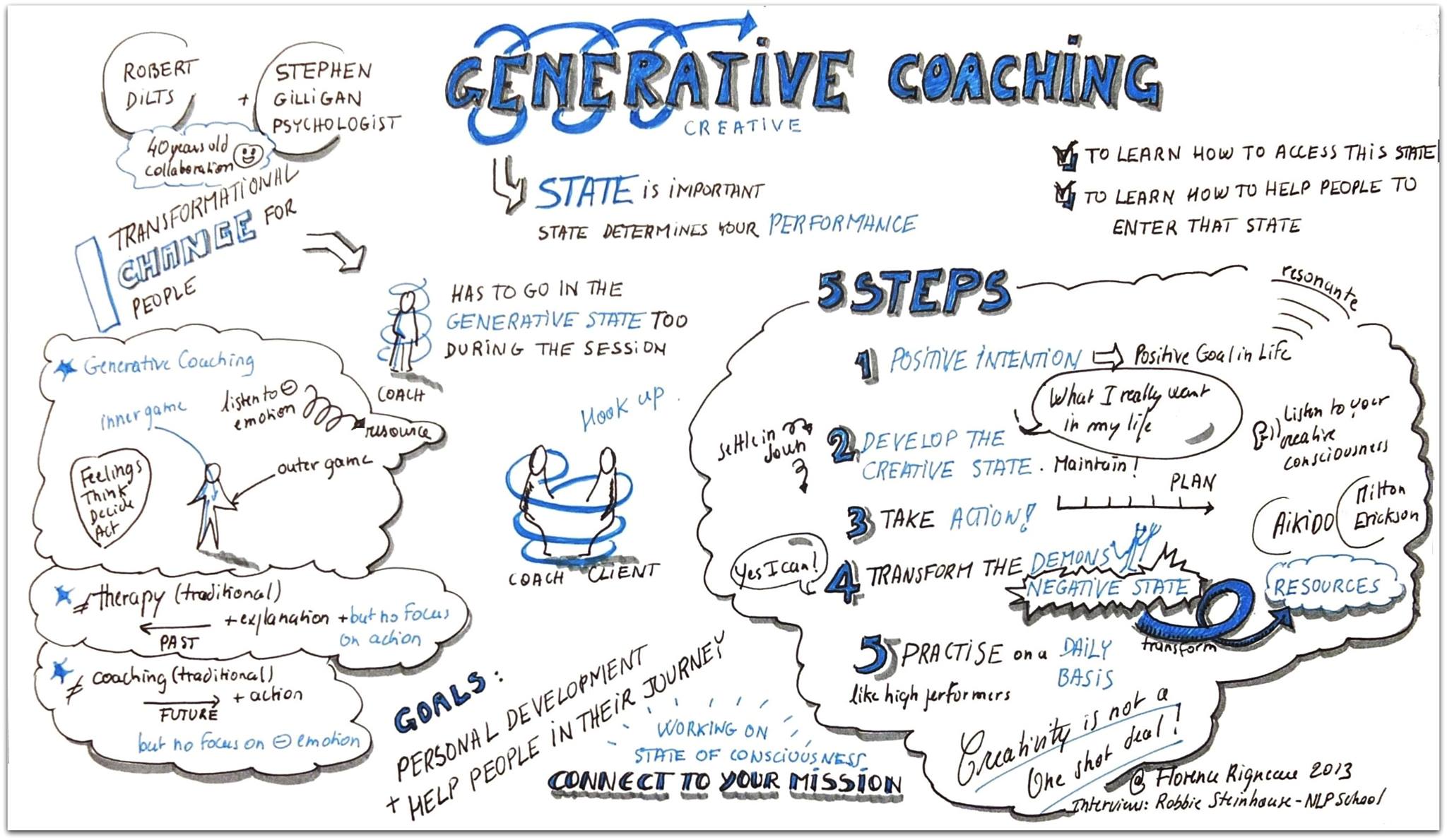 Stephen Gilligan wrote in his Blog in June about “mastering the own creative consciousness” also by “integrating dualities”. In his explanation about generative coaching he says that a coach is there to COACH and not to CRASH: a very neat use of abbreviations as summary to several elements. As coach one shall walk on the fine balance to push without cracking, leave the comfort zone but stay within resourceful states.
For me, coaching is effective if the coach stays with the client’s horizon and if the client really wants to grow – either on a business performance issue or on development. Results subsequently can be measured on levels such as feelings, learning, behavior and results; seldom though on all the 4 together. However, when coach & client together “hook up” – as it says in the graph – to achieve the goals & dreams, you often go beyond expectations. That is what inspires me to go to work every day! Kathrin
PS: Thanks to Florence to nicely summing graphically up the process of generative coaching – well done!
Existential Intelligence and the question WHY
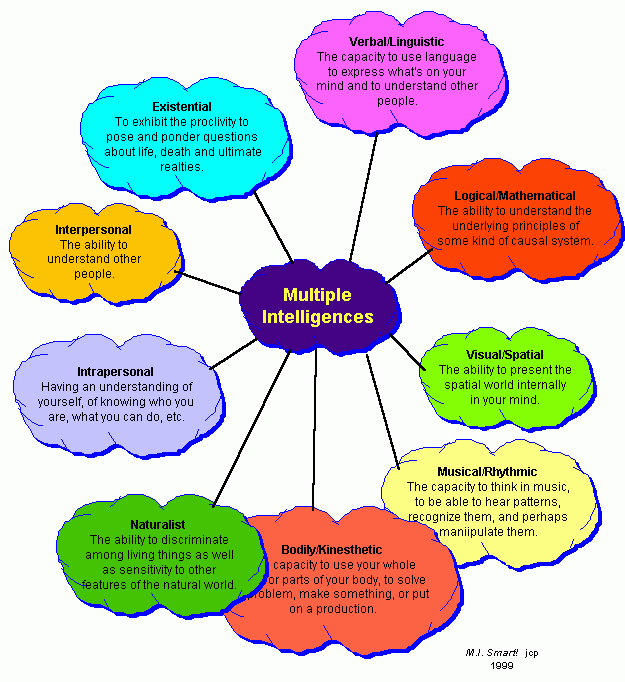 Today in preparation of a event on “how to get more women in top management” I studied the theory of multiple intelligences of Howard Gardner. Where are the factors that let women to step out of the pipeline to the C-levels? Is it because women are not as good as others to “tell their story effectively”?
Shall we in that sense follow the path that Patty Azzarello mentions in her book Rise by : Do better – Look better – Connect better? I guess that will help to a certain degree but based on my experience as coach as well as my own personal story that stops when the question: WHY? starts to come to the mind. The elements of ethical leadership like integrity, values, believes and the social impact of decisions get dominant. If I would embrace those elements I would put them into “existential intelligence” in combination with the “intra-personal” one.
That we strike for purpose along with mastery and autonomy is also the outcome of Dan Picks research on what motivates us. So we eventually shall check what purpose female leaders see in proceeding to top management and if those answers to the question WHY are in-line with what “the other side” (eg share holders, board of directors,..) expects.
One knows, there is not one typical female or male representative, however looking at all 9 intelligence listed I conclude (for myself) that females ask more often why in relation to sacrifices on ethical levels then males. Maybe because they relate to more of those intelligence at once? Who knows! Kathrin
Time to think
 This week I finally wrote a newsletter to over 500 of my contacts. The topic was time to think. Here a brief part of it with questions about taking time:
Over the last few weeks I had time to finally read articles, essays and books on leadership and its development, change management and coaching, the 3 main areas of my work. A few things were really new, most was “old stuff in a new vessel” and but some really intrigued me and I will embrace it in my work. There would be lot to share but does it help if I swap you? Wouldn’t it be wise to have time to reflect on things that are important to you? Time to analyse where you stand on leadership skill and where you’d like to strengthen your skills? Based on my experience time is the most wanted and least controlled element in our business life and “time to think” is rare. We strive for lean processes and effective actions. But are you really taking time to think?
- Do you follow the standard time management recommendation to schedule meeting each day with yourself in your agenda?
- Do you once a day take time for a fifteen-minute coffee break to allow thoughts to travel wherever they want to go?
- Do you use the resources at your hand to go through a structured thinking process using coaching?
Are there some YES answers, then congratulations, otherwise what stops you of doing one of it. In that respect I wish you “time to think” and let me know when I can be of support. Kathrin
Link newsletter or website: http://www.beachtig.ch
Enjoy simple things
Summer time is for a lot of us holiday time. And I assume most of you finally have some minutes to breath, enjoy and relax.
 Last week I was camping on a little mountain (1300m altitude) attending a music and dance festival. It was a very relaxing week from an intellectual stand point. The structure of the day was given by providing food, washing dishes (and us) as well as getting fresh water from the sole tube on the area.
Back to basic in a sense and that allowed to be taken away by a few small things. Image that you have a spectacular view to the Bernese alps while brushing your theeths. Imaging that you can leave your i-phone at a public charging place by itself for more then 2 hours and you have no worries that someone would take it away. Imaging that whenever you ask someboday a little favor you get a smile and the most willing help to support you. Imagine that you feel free and the days are flowing like the few clouds at the sky. YES that was my week last week.
And now? Is my business life so different? Are there not as many small things to enjoy every day like last week? Isn’t it a start to lift your eyes and see what beauty is around us? Isn’t it worth a try to trust into the good of other poeple. Isn’t it easy to answer with a smile when somebody needs support and isn’t it valid to ask for support and help if you need it? We can bring our holidays easily to our daily life – it is us to decide how we enjoy our given time .
Enjoy! Kathrin
Turtles all the way down

Eleven and a half year ago I got an assignment while being on holidays. I was in Ecuador and a shaman told we that I shall bring the holistic understanding of living and how the world functions back to Europe. He explained me that in his world the sun travels and that earth is balanced on 4 pillars of which each is protected by a giant turtle. The essence is, that everything is in balance and that we are part of a bigger universe.
A few years later I heard about “turtles all the way down” a little story from an old lady who told a scientist that his detailed scientific view of the universe is rubbish as there wold is carried all the way down from turtles.
Why are those two memories coming up now? At the very moment I’m preparing a seminar on brain friendly learning in which I shall use all the latest news on how our brain works to allow trainers a better transfer of knowhow and impact on changing learnings habits. And all of a sudden I remember my assignment I’ve got years back. Being a pharmacist I can explain how the brain works down to neurons. Neuronal plasticity, hemispheres and limbic systems are given terms for me. But do I really need to go that deep into details? Is a pictures like turtles holding a world not better to pass messages. Do details not blur the perspective of a holistic view? I have to admit, I need to reflect on that – and by coincidence today Is a lovely sunny day where I can watch how the sun travels the sky. Kathrin
Leadership essentials
Are you a leader? What a question. I think yes I am. But what do others say about me? Maybe I do not have time or I do not dare to ask. In that case it’s always good to reference with some public advises about leadership. On the web I found the 10 Essential Business Leadership Skills by Ben Yoskovitz, founding Partner at Year One Labs and I love to share them with you. Here what he says:
1. Lead By Example. You can’t be an aloof leader, someone that’s never around and incapable of getting your hands dirty. One of the best ways to lead is by example – pitching in where needed, lending a helping hand, and making sure that the work you do is clearly understood by your team.
2. Passion. A leader without passion isn’t a leader. He’s a paper pusher. Or a taskmaster. Or a government employee… Passion drives a lot, and you can inspire so much in others through your own passion and enthusiasm. That doesn’t mean you have to be constantly cheery, it means you’ve got to believe in what you’re doing and what your company is doing.
3. Be Organized. A disorganized leader isn’t leading, he’s chasing his own tail. Disorganization breeds nothing but more disorganization. If you’re frazzled and messy, your team will be too. When you’re organized you’ll be much more productive and so will everyone else.
4. Delegate. You can’t do everything. A great leader needs to be able to delegate effectively. The key to delegating successfully is giving employees ownership of the work you assign them. They can’t just feel like they own the work, they really have to.
5. Take Ownership and Responsibility. Although you’ve just delegated work and truly given your team ownership, you also have to take ownership and responsibility at all times. Your team has to know you’ll be there for them through the good and the bad times. That doesn’t mean you absolve people from making mistakes or ignore crappy work/effort, but it does mean you take responsibility for the big picture.
6. Communicate Effectively. Everyone knows great leaders have to be great communicators. But there are certain points of communication that many people forget. For example, it’s critical that you communicate to employees how their work matters in the bigger picture. Are they a cog, or does their work truly make a difference? Communicating success is also something leaders forget to do. People need affirmation. They want to know they did a good job. You just have to tell them.
And be precise. Insecure leaders will often ramble; uninterested leaders cut things off to quickly. Whether you’re giving praise, providing constructive criticism, or defining goals and to-dos, you have to figure out how much to say and in what order. Be precise, specific and concise. Get to the point.
7. Be Brave and Honest. Cowardly leaders will shy away from any number of situations that crop up regularly when running a team. The project your team has worked on for 6 months just got shelved. Now what? Or you have to talk to someone about their lack of effort recently. Do you ignore the problem? Or maybe it’s time to take your product into a new market. Do you hobble forward, scared and nervous, or do you grab the market by the throat? Leaders are brave. And honest. Tell it like it is. Don’t sugarcoat, don’t obfuscate. Don’t be a jerk either. You have to learn how to present things to your team in an honest but balanced manner.
8. Great Listener. A huge part of being a great communicator is being a great listener. If all you want to do is talk, you’re not a leader. Keeping people motivated means listening to them, asking them questions, understanding their issues. When you listen more, you can respond more effectively and get to the heart of things much faster.
9. Know Your People. You have to know your people. You don’t have to be best friends or even socialize outside work, but you do have to know what makes them tick. You need to know something about their personal lives because their lives outside work matter. Their lives outside work drive a great deal of their success (or lack of) at work. Keep track of simple things: birthdays, marriages, children, etc. The more you know your people the more common ground you’re likely to find, the more you’ll be able to connect.
10. Be a Follower. Benjamin Disraeli said, “I must follow the people. Am I not their leader?” That sums up many of the other points so beautifully. Great leaders are followers too. If you’re a leader without following, you’re a dictator. And as fun as that sounds… Being a leader-follower means finding value in your team, getting inspired by your team, encouraging your team to communicate, brainstorm and be open.
That are the ten point Ben lists. How are you doing with them? Overall I’m sure nothing new is there. For me the mix & balance of those elements over time make the success as it’s quite hard to do everything at the same time. I do admit that in the last few weeks I was quite self absorbed and did not have enough time to be a good leader. However I tried my best and I took advise 7 & 6 into account and was very transparent with my inability. Now things get better again and I even have time to write a blog.
 To close my thoughts: for me being a good leader is to be aware that you are human yourself and that dignity is essential to accept that others follow you by free choice – then your followers make you to be a leader at start. Kathrin
Step by Step
Tomorrow is already Ascension Day and quite a lot of us go into a long week-end by the end of today. Already more then 1/3 of the year has passed. Honestly I didn’t feel it as I was too busy to cope with what happened from day to day. But like the little note saying, day by day we live and we do not see changes but looking back…
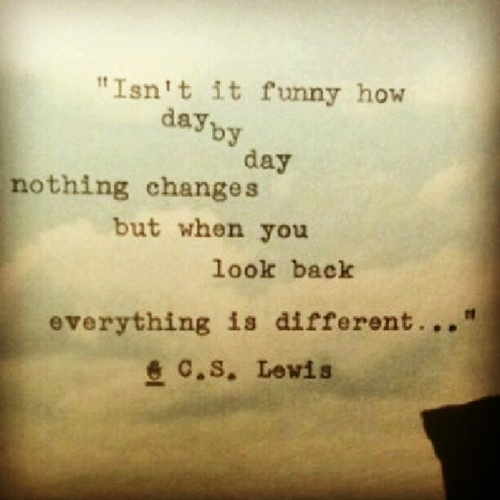 So why not using the upcoming break – while it’s raining most likely – to think about what has changed since Jan 2013 in your life?
When I start thinking instantly things come to my mind about all the changes around me such as pregnancy of a good friend, expanded business of another one, clients with new jobs, nature which awakes from winter…but that’s not what I meant: my question is geared into:
what changed for you?
For me I’m a lot calmer and centered compared to Jan 1st. I still have my dreams such as a new home which are not yet fulfilled but I’m getting clearer what I really want. So let’s see what happens in the next few weeks / months of day by day living and then when again looking back I might have some more inisghts. Enjoy the long week-end if you can! Kathrin
self limitation?
Personality vs Attitude – Limitations vs Potential – Dreams vs Daily life
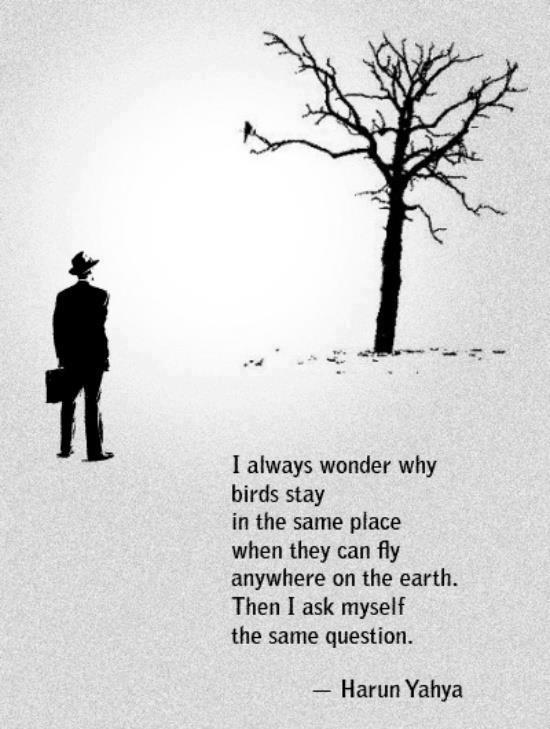
Is it really always a difference? Are we human beings staying in our comfort zone and is that less of who we can be? And is it really bad not to stay where we feel home and at ease? Birds can fly – we can change, so what stops us from doing so or do we really need to?
I’m a risk taker & coach potato at the same time. I like to travel to foreign cultures as well as stay home with a book. Since 7 year I life at the same place but in my business things changes all the time.
For me it’s the balance in-between that is needed. I cannot stretch on all areas all the time. I need some limitations – some stable elements – some home places where I can relay, where everything is known. Not traveling like a bird just because I can. Rest on a branch and save energies for future travels, yet unknown where to go. Kathrin
How to grow
Last Friday I was in a big leadership event with one of my clients. I took notes while the VP made his inspirational intro to the day. He said that we should embrace our development areas and that being on the right track does not mean we make no mistakes or that the path is always clear. We have to focus on a few things and we have to not only be technical experts in what we do, but also foster our personal growth.
In that context I like to share the following graph that I saw today on Facebook from my friend Helen Attridge, Director at the Academy of Coaching & NLP in the UK. She elaborates on growth of consciousness and asks the question where every one of us is at present. Well…a good one isn’t it?

Personally I see my path of grow since 2004 when I started my journey of personal development on a very conscious path. I sometimes really felt as victim and that I cannot change things. Overtime I grew and saw the unit of action / reaction as well as the context and the dependency in-between the elements.
And now you may ask? Oh well… when regularly meditating, while being in my ZEN retreats the world starts to get even more connected: I understand what was unclear years back, I get insights I could not be aware of as I never paid attention to. I feel that there is my place in this world and I sometimes get humble about all the elements in life.
But that is not all the time the case, sometimes there are moments of a victim feeling, or moments of control – moments is where the focus is. Having done the path so far it gets easier to proceed to further levels of consciousness. However no one of us humans is protected to fall back, see unclear, make mistakes. It all depends how fast you get conscious about what you do and that you learn from your mistakes. Kathrin
Innehalten
Der bewusst gelebte Moment kann reicher sein
als ein ganzer Tag
 Rennen die Gedanken umher kann keine Stille gefunden werden. Auf dem Philosophenweg im Engadin stand ein Zitat von Aristoteles im Sinne von “Sein und denken sind mit sich im Wiederspruch”. Die innere Mitte zu finden im Wirr Warr des Alltags ist nicht immer leicht als Konzept, doch den Moment zu geniessen, inne zu halten und zu verweilen ist einfach.
Als keiner Tipp: sich ab und zu nur auf das Atmen zu konzentrieren hilft. Kathrin

 Beachtig's blog